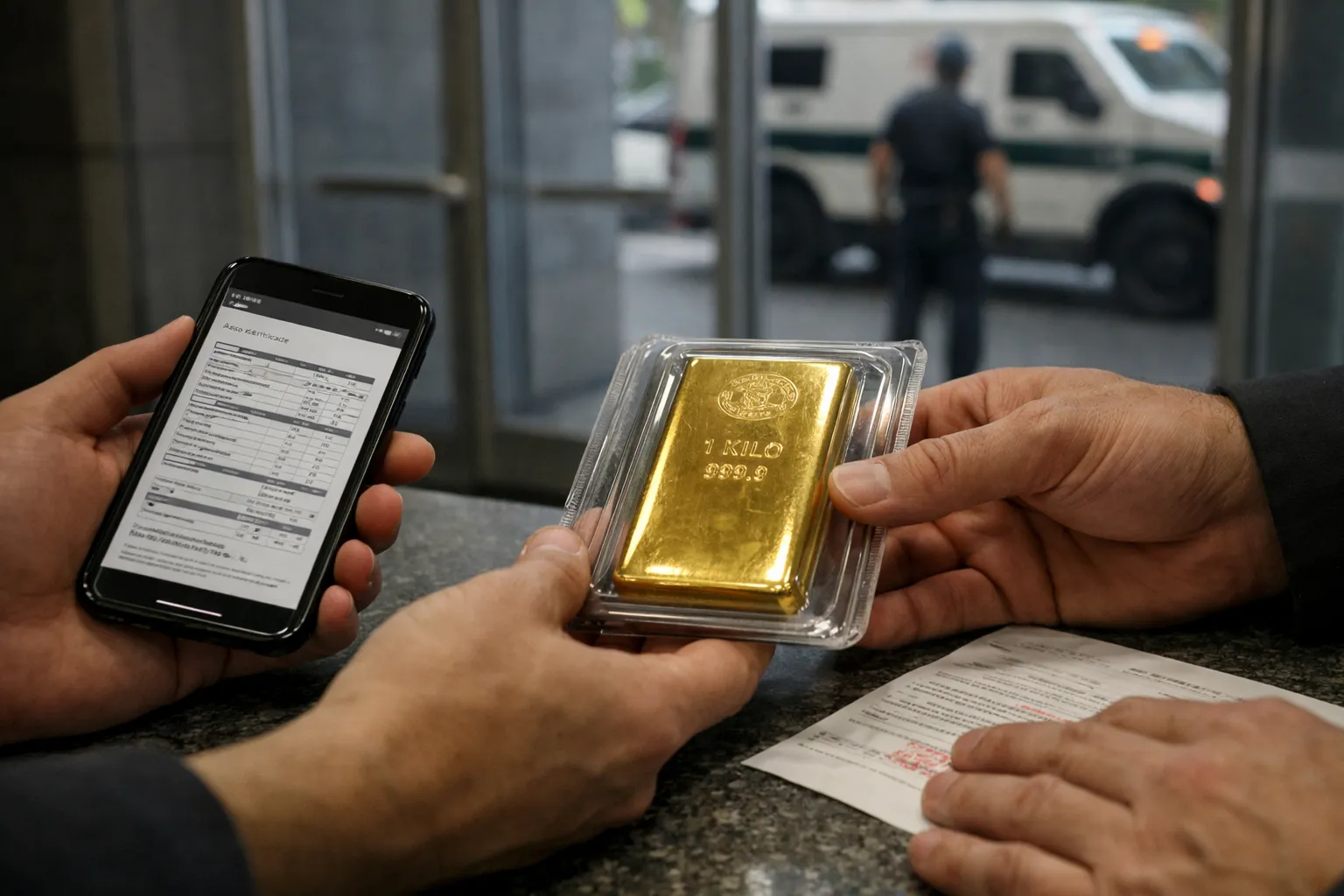
Buying gold privately — from an individual seller, auction, estate sale or small dealer — can reduce premiums and give access to unusual items. But private deals also carry higher counterparty, authenticity and logistics risk than buying from established online retailers or exchanges. This guide walks gold investors through a secure, step‑by‑step process for private bullion purchases in 2026, with practical checks, tools and a sample case to make the process repeatable and defensible.
Who this guide is for
This guide targets experienced retail gold investors and collectors who:
- Are comfortable conducting independent verification and vetting, and
- Want to buy outside standard retail channels to save on premiums or obtain rare pieces, and
- Are prepared to pay for independent assay, insured transit and secure storage.
Overview: Seven steps to a secure private bullion purchase
- Define your target, budget and acceptable condition
- Locate and vet the seller
- Agree price and payment method using escrow where possible
- Authenticate the bullion before final transfer
- Arrange insured transport or secure on‑site exchange
- Document the transaction and insure holdings in storage
- Plan your exit: resale channels and paperwork retention
Step 1 — Preparation: set your buying parameters
Before contacting sellers, decide:
- Product type: bars (1g–400 oz), rounds, government coins, or numismatics.
- Minimum acceptable fineness: 0.999+ for investment bars and modern coins; specify exceptions for historical pieces.
- Maximum premium to spot and total all‑in cost including assay, shipping, insurance and potential tax.
- Payment methods you will accept (bank transfer, escrow, certified cheque); avoid large cash deals unless you have robust counterparty vetting.
- Whether you plan to take physical possession or move the metal directly to a professional vault.
Having clear parameters lets you walk away from risky offers quickly.
Step 2 — Finding and vetting the seller
Sellers can be:
- Individuals on local marketplaces or classifieds
- Auction houses and estate sale specialists
- Small regional dealers or refiners
- Collectors selling peer‑to‑peer.
Vetting checklist:
- Online footprint: search the seller’s name, phone, email and business for complaints, reviews and known fraud reports.
- Request government ID and proof of ownership (receipts, prior assay certificates, provenance documentation).
- Ask for serial numbers, high‑resolution photos of both faces and edges, and hallmark stamps or refiner marks.
- Check past auction records for identical pieces (helps verify rarity premiums for numismatics).
- Confirm willingness to use escrow or third‑party inspection before final payment.
Red flags: evasive answers, inconsistent serial numbers, refusal to meet in person for a professional assay, or pressure to pay cash immediately.
Step 3 — Pricing and negotiation
Price elements to consider:
- Spot gold: use a reliable market feed at the time of the deal.
- Premiums: typical premiums vary by product — modern 1oz coins often carry 1–4% over spot when bought retail; private sales can be lower or higher depending on rarity and liquidity.
- Assay costs: XRF or ultrasonic tests and third‑party assays typically cost from a few tens to a few hundred dollars depending on size and service.
- Shipping/insurance: insured courier and vault delivery are non‑negligible — budget 0.2–1% depending on value and route.
- Taxes: local VAT, sales tax or collector tax can change the effective cost — consult a tax professional.
Always compute an all‑in price before committing. For high‑value deals, agree pricing and payment terms in writing (email record is fine) and include inspection windows and return provisions.
Step 4 — Authentication: tools and procedures
Use a layered approach — no single test is definitive.
Basic, low‑cost tests
- Visual inspection: hallmarks, refiner marks, and consistent wear; compare against manufacturer specifications for weight and dimensions.
- Weight and dimensions: measure mass to 0.01 g and dimensions with calipers; compare to published tolerances.
- Magnet test: real gold is non‑magnetic; magnets detect ferrous or some plated fakes.
- Specific gravity: inexpensive hydrostatic tests can spot large deviations (pure gold density: 19.32 g/cm³).
Advanced testing (recommended for high‑value purchases)
- XRF (X‑ray fluorescence): non‑destructive and widely used; reveals surface alloy composition but can be fooled by heavy plating.
- Ultrasonic testing and acoustic resonance: identify internal voids, layering, or non‑homogeneous structure; useful for bars.
- Fire assay (destructive): the gold‑standard for accuracy, used rarely and only on test samples; acceptable when authenticity is legally disputed.
- Third‑party assay labs or refiner verification: send the bar/coin or a representative sample to a well‑known assayer or refiner for certificate of authenticity.
For most private deals above a certain threshold (suggested US$10,000+), require at least one advanced test or a third‑party assay certificate before final payment.
Step 5 — Secure payment and escrow
Payment strategies to minimize fraud:
- Escrow services: use reputable escrow providers that hold funds until authentication and delivery are confirmed. Escrow reduces counterparty risk — insist on it for large sums.
- Bank transfers: traceable and reversible only in cases of fraud; prefer transfers to business accounts with matching entity names.
- Avoid cash and anonymous payment systems unless you can meet and inspect the metal and complete the exchange in a secure location.
- Certified cheques or bankers’ drafts carry risks of forgery; confirm funds with issuing bank where needed.
Escrow provider selection: use established, regulated providers; check company registration, trust account arrangements and dispute procedures.
Step 6 — Transport, handover and storage
Options:
- On‑site professional inspection and exchange: meet at a bank vault or an insured broker’s office so the buyer inspects before releasing funds.
- Insured courier to vault: seller ships via an insured precious‑metal courier (Brinks, Malca‑Amit, or equivalent) directly to the buyer’s designated vault. Buyer pays after the courier confirms delivery to the vault and acceptance.
- Local face‑to‑face exchange in a public, secure place (e.g., bank branch) with ID checks and receipt documentation.
Storage: if you do not take delivery, transfer immediately to an allocated and insured vaulting provider. Home storage increases theft risk and can complicate insurance claims.
Step 7 — Insurance, documentation and exit planning
Insurance:
- Transit insurance: ensure the courier or escrow arrangement includes transit insurance up to the declared value.
- Storage insurance: confirm your vaulting provider carries full insurance and that your policy losses are covered for the declared value; get written evidence.
Documentation — keep:
- Purchase invoice with serial numbers and weight/fineness;
- Photographs of the metal before shipping;
- Assay certificates, escrow receipts, courier tracking and insurance documents;
- Any correspondence defining the terms of the deal.
Exit planning:
- Identify resale channels (auction houses, brick‑and‑mortar dealers, vault buybacks, or private sales) and expected liquidity for your specific item.
- Retain original documentation and assay certificates — they materially affect resale price and speed.
Case study: Buying a 1kg cast bar privately in 2026 — practical walk‑through
Scenario: You find a privately listed 1kg cast Swiss‑style bar from a known refiner, asking price spot + 0.9% (April–September 2026 volatility tightened, but premiums on private deals remain compressed).
- Preparation: You set an all‑in cap of spot + 1.8% (accounting for assay, insured courier and vault fee).
- Vetting: Seller supplies high‑res photos, serial number, and a scanned receipt from a refinery. You search serial number against prior auction listings — no matches, not definitive but informative.
- Authentication plan: Buyer requests an on‑site XRF test and ultrasonic scan before release of funds. Seller agrees to meet at an independent bullion dealer who has testing equipment and acts as a neutral witness.
- Payment: Parties agree to use a reputable escrow service that holds buyer funds until dealer confirms test results and delivery to a secure vault.
- Handover: Tests pass (XRF shows 999+, ultrasonic consistent with solid bar), escrow releases funds, courier collects and delivers bar to buyer’s allocated vault. Courier insurance covers transit.
- Post‑transaction: Buyer receives vault entry certificate, stores assay/test reports and invoice in digital and physical form, and updates insurance provider.
Common pitfalls and how to avoid them
- Relying on a single surface test — combine XRF with dimensional/specific gravity and, for high values, ultrasonic or third‑party assay.
- Cash deals without documentation — always obtain invoices and proof of ownership.
- Failing to budget for shipping, assay and insurance — they can exceed perceived savings.
- Ignoring KYC/AML: in many jurisdictions, large private sales trigger reporting or ID requirements; be prepared to provide identification and to use regulated escrow providers.
Regulatory and tax considerations (quick summary for 2026)
Rules vary by jurisdiction. Highlights to consider in 2026:
- Many jurisdictions have tightened AML/KYC controls for precious‑metal dealers and transfers — expect ID checks and reporting on large cash transactions.
- Tax treatment differs: in the US, gains on physical gold are treated as collectibles for capital gains (up to a 28% rate for long‑term gains); in the EU and UK, investment gold (bars and qualifying coins) usually enjoys VAT exemption, but numismatic items and certain rounds may not. Always confirm current local rules with a tax advisor before a significant purchase.
Checklist: before you pay
- Have defined product specs and a maximum all‑in price.
- Verified seller identity and reviewed provenance documents.
- Agreed on escrow or payment method.
- Insisted on at least two authentication tests for high‑value items.
- Arranged insured courier or met in a secure, neutral location.
- Secured vaulting and storage insurance options in advance.
- Retained all documentation and update your tax records.
Conclusion
Private bullion purchases can offer cost advantages and unique items, but they require discipline: defined buying parameters, thorough vetting, layered authentication and secure logistics. In 2026, with tighter regulatory scrutiny and more sophisticated counterfeits in circulation, a conservative approach that uses escrow, independent testing and insured vaulting will protect both the metal’s value and your legal/financial position. When in doubt, pay a few percentage points in premiums to transact through a regulated dealer — the added certainty often outweighs the savings from a risky private deal.