Executive summary
For gold investors in 2026 the choice of where and how to keep metal—allocated vaulted bars, unallocated bank/dealer accounts, or physically backed ETFs—remains a core strategic decision. The trade-offs are predictable: allocated storage maximizes legal ownership and auditability but costs more and limits instant liquidity; unallocated and ETF structures offer lower headline fees and faster market access but bring counterparty, rehypothecation and traceability risks.
Why storage method matters now
After a multi-year period of elevated macro volatility and regulatory attention to custody and traceability, custody choices have a direct impact on returns (via fees and spreads), operational flexibility (how quickly you can convert metal to cash or move across jurisdictions), and legal exposure (title, insolvency, and audit certainty). Investors who treat gold as insurance or long-duration wealth preservation often prioritize legal segregation and physical control; traders and tactical allocators typically prioritize low friction and intraday liquidity.
How the three models work
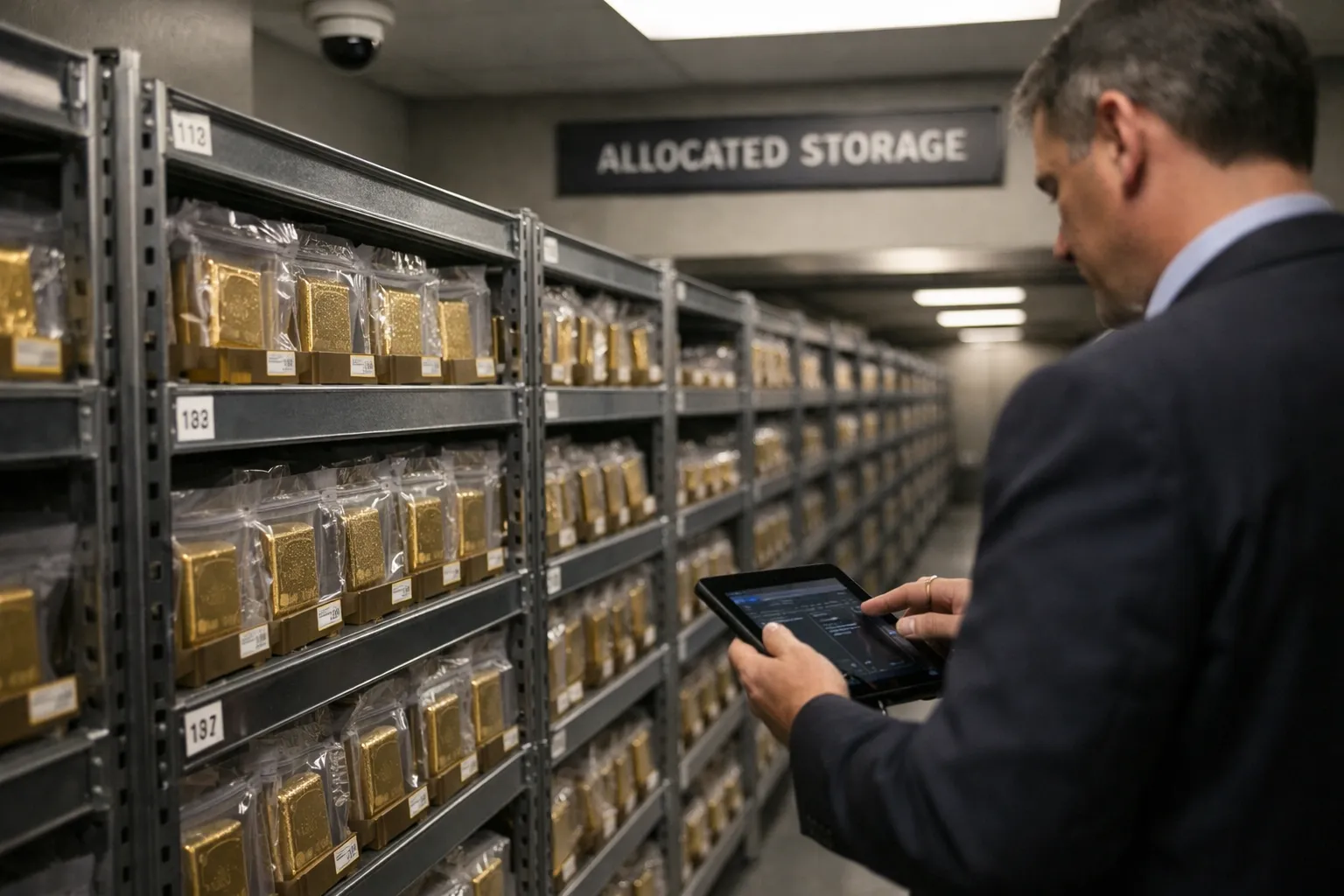
Allocated vaulted storage
Allocated storage means specific bars or coins assigned to an investor, stored in a vault under the client’s name or unique reference. The custodian maintains an inventory record and issues receipts. Transfers involve movement of physical inventory or change of title. Typical providers: private vault operators, specialised bullion banks and some national mints.
Unallocated accounts
Unallocated accounts are ledger balances where the bank or dealer owes metal from a collective pool; the customer has a creditor claim rather than title to specific bars. These accounts are cheaper and allow quick settlement, but they expose the holder to the custodian’s credit risk and to rehypothecation (the firm re‑using the metal).
Physically backed ETFs
Physically backed ETFs (e.g., US and European products) hold bullion in vaults and issue shares that represent a pro rata claim on the pool. ETF investors gain intraday liquidity via exchanges; however, the legal framework differs by domicile and product—shareholders typically have a beneficial claim rather than direct title to specific bars. Expense ratios cover custody, insurance and administration; liquidity costs include market spreads and creation/redemption mechanics.
Breaking down the costs — a worked example
Assume a long‑term investor holds 100 troy ounces with a spot price of $2,000/oz (portfolio value: $200,000). We compare three representative annual cost buckets (figures illustrative but conservative):
- ETF (physically backed): expense ratio 0.25% (some funds 0.20–0.40%), bid/ask spread on market trades ~0.10% when liquid. Annual custody/operational cost: $500; round‑trip liquidity friction small on normal days.
- Allocated vaulted storage (commercial vault): storage + insurance 0.30%–0.60%; dealer buy/sell spread on physical bars 0.50% retail. Annual custody cost (at 0.45%): $900; selling incurs additional dealer spread when liquidating physical metal.
- Unallocated account: fees possible 0.10%–0.25%; but counterparty credit risk and possible additional costs if the provider restricts redemptions in stress. Annual fee at 0.20%: $400, with potential hidden risk premiums.
Net of immediate liquidity costs, an ETF can be the cheapest route for an investor focused on tradability: $500 in annual fees plus low spread costs. Allocated storage costs more on an ongoing basis but can be cheaper over multiple years if the investor avoids repeated buy/sell dealer spreads and values legal title. Unallocated accounts are lowest‑cost but carry embedded credit exposure that may warrant a “risk premium” depending on counterparty strength.
Liquidity and settlement: who wins?
- ETFs: Best for intraday liquidity. Shares trade on an exchange and large trades can be settled via authorised participants through creation/redemption—fast and efficient for marketable-sized positions.
- Unallocated accounts: Near-immediate settlement with the provider; conversion to physical or cash depends on the provider’s operational model and can be quick for institutional clients.
- Allocated vaults: Slowest. Converting bars to cash typically requires selling to a dealer, arranging shipment/assay or physical transfer—days to weeks. For small investors, shipping and certification add time and cost.
Counterparty, legal and operational risks
Key considerations:
- Legal title: Allocated storage preserves direct ownership over specific bars. ETFs and unallocated accounts offer beneficial or creditor claims—sufficient in normal markets but complicated in insolvency.
- Rehypothecation and lending: Unallocated metal is commonly lent or rehypothecated; ETFs generally do not lend the underlying metal (though some funds may lend securities exposures), but read prospectuses.
- Auditability & provenance: Allocated metal with serial numbers enables provenance tracking. ETFs rely on custodian reporting and periodic audits; for large investors provenance and ESG compliance can matter.
- Jurisdictional risk: Vault location affects legal protections, import/export restrictions and repatriation ease. Switzerland, Singapore and London remain popular for diversification but choose vaults with proven audit trails.
Tax, reporting and regulatory points to check
Tax treatment of gold (capital gains, VAT/exemptions, import duty) varies by domicile and product structure. ETFs may be treated differently from physical holdings for tax reporting and withholding. Investors should confirm local rules for bullion ownership, stamp or sales taxes on physical movements, and how ETFs are taxed on distributions and capital gains.
Which approach for which investor?
- Short-term traders and tactical allocators: Physically backed ETFs or unallocated platforms for speed and low friction.
- Long-term wealth preservation (private investors): A core holding in allocated vaulted storage—preferably split across two jurisdictions for geopolitical insurance—plus a small ETF sleeve for tactical needs.
- High‑net‑worth and institutions: Allocated storage for large base positions (legal title, audit trail) and ETF/unallocated overlays for liquidity and synthetic exposures.
- Smaller investors with storage constraints: Low‑fee ETF exposure remains practical; choose funds with transparent custody arrangements and low expense ratios.
Practical checklist when selecting a provider
- Confirm whether holdings are allocated, segregated, or unallocated and request sample custody agreements.
- Inspect insurance limits, policy wording, and whether coverage includes political or shipment losses.
- Check audit frequency and availability of independent third‑party inventory reports.
- Understand fees: storage, insurance, inbound/outbound handling, shipping, assay and minimums.
- Verify redemption mechanics and expected settlement timelines in normal and stressed markets.
- Assess jurisdictional issues: capital controls, likely ease of repatriation, and local tax treatment.
- Confirm dispute resolution forum and insolvency treatment of client property.
Conclusion — a pragmatic approach for 2026
There is no one-size-fits-all answer. For investors who prioritize legal ownership, auditability and long-term capital preservation, allocated vaulted storage remains the superior—but costlier—choice. For those prioritizing liquidity and low headline fees, physically backed ETFs provide a pragmatic, liquid instrument. Unallocated accounts have a role for cost‑sensitive investors with strong counterparty oversight but should not be treated as equivalent to holding bars.
A blended approach—an allocated core for long-term security plus a tradable ETF sleeve for tactical flexibility—often delivers the best balance between cost, control and liquidity. Whichever route you choose, run the numbers on all cost components (fees, spreads, taxes) and stress-test your counterparty and jurisdictional assumptions before committing significant capital.