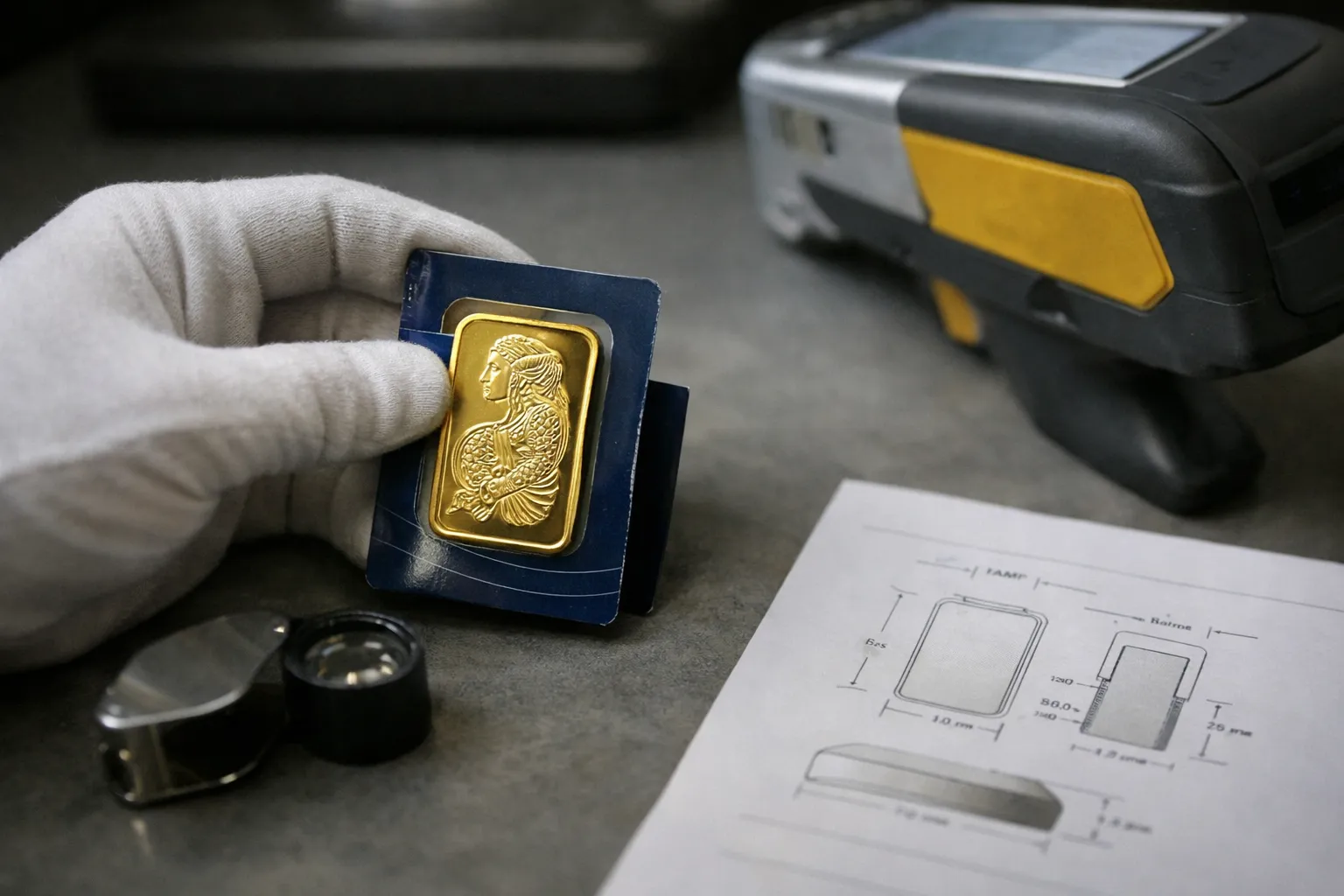
This updated guide explains how to authenticate and buy secondary‑market gold bars and coins in August 2026. It’s written for private investors and collectors who want lower premiums or rare pieces but need a practical, up‑to‑date verification routine that reflects new counterfeiting techniques, testing tools and market practices developed through 2024–2026.
Why this matters: fraud is costlier and more sophisticated than it was even two years ago, while verification tools and provenance services are more accessible. This piece gives step‑by‑step actions, current trade practices, and specific checks you should use before, during and after a purchase.
Prerequisites / Context
Before you begin, make sure you have:
- A calibrated precision scale (0.01 g resolution recommended for coins and small bars).
- A set of digital calipers and a soft measuring surface.
- Access to a reputable third‑party assay lab (look for ISO/IEC 17025 accreditation) or a dealer that will authenticate on receipt.
- Familiarity with the maker’s published specs (weight, dimensions, hallmark placement) for the items you buy.
- A plan for insured transport and escrow if buying peer‑to‑peer or from unverified sellers.
Why the secondary market needs a different playbook in 2026
Two trends since 2024 make a disciplined approach essential:
- Counterfeiters increasingly combine traditional plating/tungsten‑core techniques with modern tools: laser‑etched serials, two‑tone plating and convincingly edited photos or AI‑generated documentation. Photo and signature fraud using generative AI have become routine in some listings.
- Verification technology and provenance services have become more accessible. Portable analytical devices (XRF, LIBS, ultrasonic array testers) reached broader availability among dealers in 2025–26, and several refiners and vault providers are piloting digital, tamper‑evident certificates and NFC/QR overlays to bind physical bars to a verifiable digital record.
The result: visual inspection alone is riskier, but investors now have more reliable, affordable testing options—if they use multiple, complementary methods and insist on documented chain‑of‑custody.
Step 1 — Pre‑purchase: research the item and seller
- Identify the exact item and intended use. Record refiner/mint, nominal weight (troy ounces/grams), serial number (if any), hallmark locations and edition details (coin year, mint mark, slab grade if applicable). Decide whether you intend immediate resale, long‑term storage, or delivery to a vault—this affects acceptable provenance and packaging.
- Download maker specifications. Visit the refiner or mint website (PAMP, Valcambi, Argor‑Heraeus, Perth Mint, etc.) and save official specs and hallmark images to your phone. These images are the baseline for visual comparison.
- Vet the seller thoroughly. Prefer regulated, established dealers with physical addresses, industry memberships and clear return policies. For online marketplaces and classifieds, insist on escrow, verified ID (KYC), and in‑person inspection or certified third‑party authentication before release of funds.
- Request full documentation up front. Ask for high‑resolution photos of obverse/reverse/edges, any assay card or certificate, original receipt, and provenance notes (previous owner, purchase date). Be suspicious of listings that post generic images or reuse manufacturer product shots without provenance.
Step 2 — Red flags before you pay
- Listings using stock images, AI‑generated photos, or with mismatched serials in different pictures.
- Seller refuses detailed edge photos or to allow third‑party inspection/escrow.
- Price materially below market (spot + realistic premium) for the weight and brand—especially for large bars.
- Pressure to pay with untraceable methods, or insistence on immediate wire without escrow for high‑value items.
- Documentation that can’t be validated—e.g., certificate numbers not found in the refiner’s registry (when the refiner maintains one).
Step 3 — In‑person or remote authentication tests (what to run and why)
Whenever value is material, combine multiple, complementary tests. No single test is definitive; each catches different fraud types.
Visual inspection
- Compare hallmarks, font, relief depth and logo proportions to the maker’s images. Counterfeits often have subtle digressions in letter spacing, relief crispness or micro‑text.
- Check serial numbers—laser‑etch depth, alignment, and character profiles. Repeated digits or inconsistent engraving depth are warning signs.
- Examine edges for seams, rim irregularities, or two‑tone lines indicating plating over a core.
Weight, dimensions and specific gravity
- Weigh on a calibrated scale. A 1 troy ounce coin = 31.1035 g; confirm to ±0.02 g for reputable pieces.
- Measure length/width/thickness with digital calipers and compare to published specs—counterfeits often match mass but not dimensions.
- Specific gravity test (water displacement) remains a low‑cost, non‑destructive density check—pure gold ≈ 19.32 g/cm³. Conduct carefully to avoid damaging special finishes or slabbed coins.
Non‑destructive analytical tools
- Handheld XRF (X‑ray fluorescence) — quickly reads elemental composition at the surface. In 2026 many regional dealers use newer XRF units with improved calibration libraries; still remember XRF reads the near‑surface and can be cheated by thick gold plating.
- Portable LIBS (Laser‑Induced Breakdown Spectroscopy) — increasingly available to dealers by 2025–26, LIBS can profile slightly deeper than XRF and is more likely to detect layered or plated structures when used by trained operators.
- Ultrasonic array and pulse‑echo testers — these detect internal laminations, voids or composite cores. Newer units provide visualized cross‑section profiles and are effective for bars and larger items.
- Electrical conductivity/resistivity meters — gold has predictable conductivity; modern bench units flag mismatches that may indicate alloying or core metals.
- Magnet and simple scratch tests — quick initial screens (gold is non‑magnetic). Never rely solely on these.
Remote authentication services and slab verification
For coins, slabbed and graded pieces from PCGS and NGC are still the safest secondary purchases because the slab cross‑reference and lab grading reduce risk—use each company’s serial lookup. Expect dealers to accept grade verification screenshots and to allow return if slab numbers do not match registries.
Third‑party assay and destructive tests
If the item is high value or tests are ambiguous, send it to an independent, ISO/IEC 17025‑accredited assay lab for fire assay (destructive and definitive) or to a recognized vault that offers assay and reseal services. Labs now commonly provide photographed chain‑of‑custody documentation and time‑stamped digital reports usable in disputes.
Step 4 — Chain‑of‑custody, escrow and insured settlement
- Use escrow for peer sales. Choose escrow providers familiar with precious metals transactions and with documented dispute resolution records.
- Insure transport appropriately. Require insured carriers experienced with precious metals (major secure couriers and vault providers). For high‑value items, prefer armored transport or insured vault transfers.
- Document every step. Photograph packaging before opening, keep tracking records, save emails and test reports. If you use a third‑party assay, request chain‑of‑custody photos and a signed report.
Step 5 — Post‑purchase verification and recourse
Run your full verification routine immediately on receipt. If anything fails or looks suspicious:
- Do not melt, alter or deposit the item in a way that prevents independent testing.
- Notify the seller with documented evidence (photos, lab reports) and open an escrow dispute if applicable.
- File claims with the carrier’s insurance if shipment was damaged or misdescribed.
- Use an accredited lab report as the basis for recovery action; many insurers and escrow services require ISO/IEC 17025 documentation.
Practical checklists (updated for 2026)
Pre‑purchase checklist
- Item fully identified (maker, weight, serial, slab grade).
- Maker specs and hallmark images saved locally.
- Seller credentials verified; KYC if peer sale.
- Escrow/insurance and return terms confirmed in writing.
- High‑res photos, provenance, and certificate numbers requested.
On‑receipt checklist
- Photograph package before opening and the item immediately after.
- Weigh and measure against published specs.
- Perform visual hallmark and serial comparison.
- Run at least one analytical scan (XRF or LIBS) and an ultrasonic quick check if available.
- Document anomalies and notify seller within the return window.
Cost and time tradeoffs (2026 perspective)
Expect verification costs to be a non‑trivial portion of the transaction for material purchases. Typical ranges in 2026:
- Local dealer quick scans (XRF/LIBS/ultrasonic): often $25–$150 per item.
- Independent, ISO‑accredited lab assays (non‑destructive reporting): $150–$400; destructive fire assays for definitive proof: $300–$800 plus shipping and handling.
- Escrow fees vary by platform and value—budget 0.5–2% of transaction value for reputable services on high‑value sales.
Balance these costs against your premium savings and the value of peace of mind. For premium rarities or bars >1 kg, lab assays and insured transport are typically cost‑effective relative to potential loss.
Where to get help
Use local, well‑reviewed dealers for in‑person purchases. For large or unusual lots, contact independent assay labs with ISO/IEC 17025 accreditation and insured vault providers who can authenticate, reseal and store. Coin buyers should consult grading registries (PCGS, NGC) and ask for slab serial verification. If you suspect fraud, report to local law enforcement and, for U.S. buyers, consider alerting the FBI’s Internet Crime Complaint Center or relevant financial authorities depending on jurisdiction.
Common buyer mistakes and how to avoid them
- Relying on photos alone. Demand independent verification for material purchases.
- Equating low price with value. A bargain appearance can mask plating or cores—always factor verification costs into the decision.
- Skipping documentation. Insist on receipts, provenance and escrow records; these are essential for insurance and resale.
- Trusting single‑test results. Use at least two complementary methods (e.g., XRF + ultrasonic) before accepting high‑value items.
New practices gaining traction in 2026
- Refiners and vaults increasingly offer optional digital provenance (tamper‑evident certificates linked to a QR/NFC tag). These make resale easier but are not yet universal—always cross‑verify the on‑chain record with physical markers.
- Buyers and dealers are standardizing on ISO/IEC 17025 assay reports for dispute resolution—insurers and escrow providers often accept these as the gold standard.
- Marketplaces and dealers now routinely require KYC and AML checks for transactions over regulatory thresholds, reducing anonymous bad‑actor activity but increasing paperwork for buyers.
Quick case study (realistic, composite)
Buyer B purchased a 250 g branded bar from a regional dealer in early 2026. The dealer offered an on‑site LIBS scan and ultrasonic array check for a modest fee. LIBS matched expected alloy profile and ultrasonic profile showed solid homogeneity. The bar included a refiner QR certificate linking to a tamper‑evident record. Buyer B paid by bank transfer through the dealer, had the piece insured in transit to a private vault, and received an ISO‑17025 non‑destructive report from a partner lab the following week. The total verification cost amounted to fewer than 1.5% of the purchase price; the investor felt comfortable holding the metal for the long term because of documented provenance and independent lab confirmation.
Final rules of thumb
- Assume verification costs for any material purchase and build them into your offer.
- Prefer verifiable chain‑of‑custody, independent lab reports and documented provenance—these materially simplify resale and insurer claims.
- Always use at least two complementary tests (visual + mass/dimensions + analytical method) before final acceptance.
- When in doubt, send the item to an accredited lab or purchase from a dealer that guarantees authenticity in writing.
FAQ
How reliable is handheld XRF in 2026?
Handheld XRF remains a fast, useful tool for surface composition and is widely used by dealers. It is reliable for confirming surface alloys but can be fooled by thick gold plating over base metals. For high‑value items use XRF alongside a depth‑sensitive test (LIBS, ultrasonic) or an independent lab assay.
Should I trust digital certificates and QR/NFC tags?
Digital certificates and tamper‑evident QR/NFC tags are a valuable additional provenance layer, and several refiners and vaults began offering them in pilot programs through 2025–26. They help with provenance but are not a substitute for physical inspection and lab tests—digital records can be forged or reissued if the physical item is altered.
When is a destructive fire assay justified?
Fire assays are definitive and necessary when analytical tests conflict or when a dispute over high‑value metal cannot be resolved otherwise. Use them when the potential loss exceeds the assay cost and after consulting your insurer and an accredited lab about chain‑of‑custody and sampling protocols.
Can I rely on slabbed coins only?
Slabbed coins from major grading services (PCGS, NGC) greatly reduce fraud risk because slabs have serial verification and graded authenticity. However, slab counterfeits and re‑slabbing scams exist—verify slab serials through the grading company and, for very large purchases, consider an independent authenticity check as a precaution.
What if a seller refuses escrow or third‑party authentication?
Refusal is a major red flag. For anything material, do not proceed without escrow, documented KYC, or an agreed‑upon third‑party authentication step. Walk away rather than accepting unexplained risk—recovering funds after fraud is much harder than preventing it.
Secondary‑market gold remains an attractive source of variety and potential savings in 2026, but it requires a disciplined, multi‑test approach and clear documentation. Use the updated checks above, insist on provenance and ISO‑accredited reports when value is material, and integrate verification costs into every offer you make.