
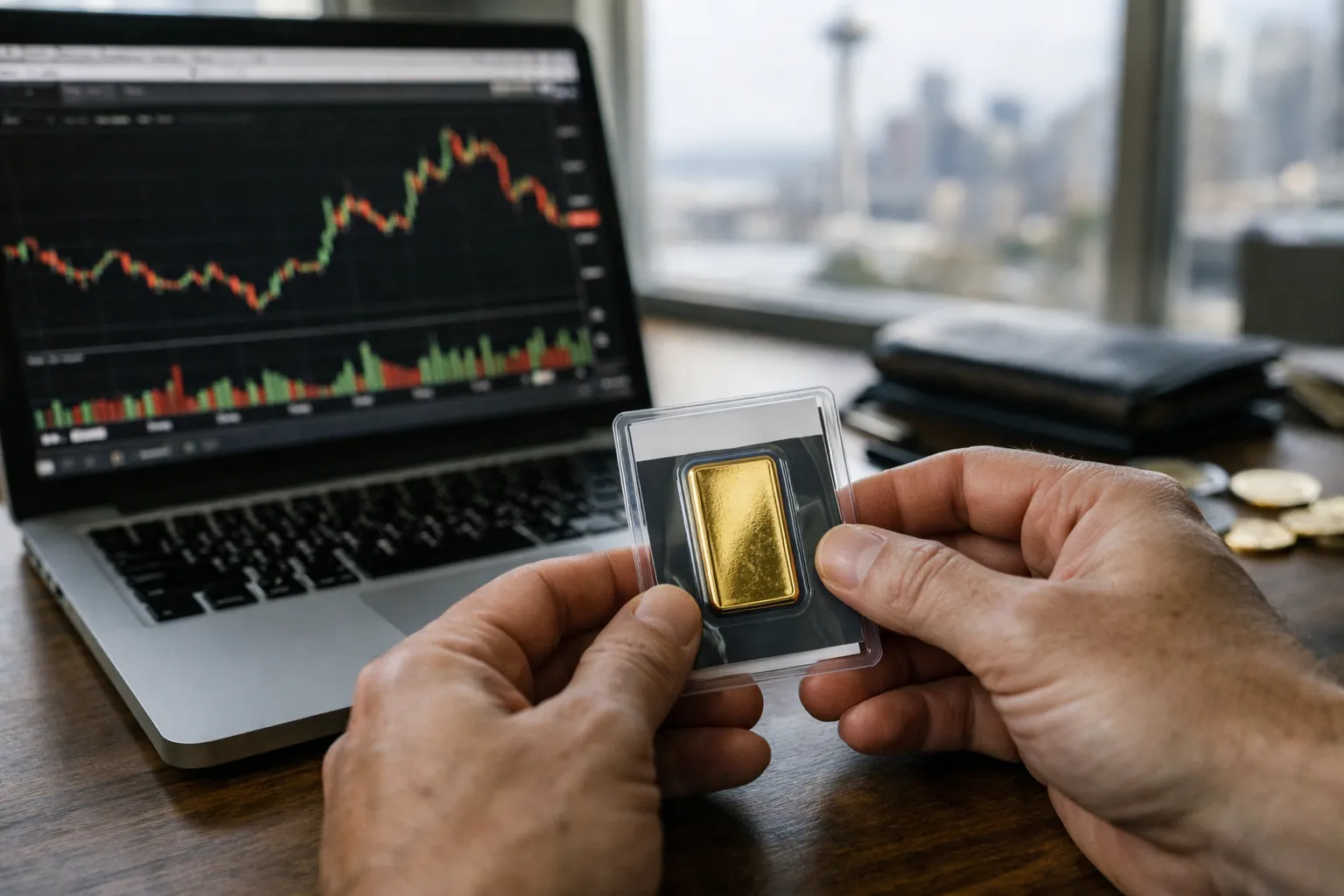
Product reviewed: Costco listings for 1 troy ounce (31.1035 g) minted gold bars commonly sourced from refiners such as PAMP Suisse and Rand Refinery, sold to Costco members (online drops and occasional in-warehouse availability) as of July 2026.
Overview: What are we reviewing? Key specs at a glance
- What it is: 1 oz minted investment gold bars from established refiners (typically PAMP, Rand).
- Purity: Commonly .9999 fine (24k) for PAMP; verify each Costco listing for specific maker and assay details.
- Packaging: Many PAMP pieces come sealed in assay cards with visible serial numbers—preserve seals and receipts.
- Availability: Still sporadic. Online drops often sell out quickly; occasional in-warehouse offers persist in some metros.
- Purchase limits: Historically 1–2 bars per member per transaction; limits still vary by listing and region—expect them to remain in place.
- Return policy: Costco’s general satisfaction policy applies to most merchandise, but precious-metals listings often note restricted or final-sale terms—always confirm at checkout.
Background: Who makes this? What's the target audience?
Costco is a mass-retailer with scale, not a bullion specialist. The bars are produced by established refiners and re-sold to Costco members. The target buyers remain unchanged: members who want recognizable 1 oz gold pieces without opening an account at a specialist dealer or navigating ETF custody. Convenience and brand recognition are the primary selling points.
That convenience must be balanced against the numbers: the purchase premium, sales taxes, and expected resale bid are the three variables that determine whether Costco is a good option. The numbers tell a different story than marketing copy—run the arithmetic before you click Buy.
Features analysis: A deep dive into capabilities (and fine print)
1) Pricing: premiums and what recent data show
Through H1 2026 market observations, retail premiums for branded 1 oz minted bars at mainstream sellers—including opportunistic Costco listings—have clustered around 2%–4% at point of sale, with an average near ~3.5% on many drops. That is slightly tighter than the broader 2%–6% band seen in prior years due to intensifying competition among online dealers and more frequent "guaranteed-bid" programs.
How to judge a Costco listing in real time: get a live spot price (CME/COMEX or a reliable market feed) and compute premium = (Costco price − spot) ÷ spot. Example math to keep handy: if spot is $2,200/oz and Costco lists at $2,288, premium = $88 / $2,200 = 4.0%.
2) Membership rewards — still useful but conditional
Costco’s Executive 2% reward can materially offset a portion of the premium, but the reward only benefits you if (a) your membership qualifies for Executive rewards, (b) the bullion purchase is eligible under Costco’s reward calculations, and (c) you haven’t already hit any annual reward cap. In practice, treat the 2% as a possible but not guaranteed offset—verify your member statement before factoring it into a buy decision.
3) Sales tax: the single biggest drag
State tax treatment remains the dominant determinant of whether Costco is competitive. Concrete examples:
- If your state charges 6% sales tax: a $2,288 purchase becomes $2,425 — a non-recoverable 6% headwind.
- In tax-exempt states, that 6% drag vanishes and Costco’s convenience becomes more meaningful.
Decision rule: add sales tax to your premium calculation and treat it as irrecoverable cost for resale math. In taxed jurisdictions, retail buys at Costco are often less attractive than using tax-exempt dealers, buying via exempt channels, or ETFs.
4) Authenticity, packaging, and liquidity
PAMP and Rand remain high-recognition brands; sealed assay cards with matching serials help liquidity. Dealers typically perform handheld XRF or visual inspections on resale—this is standard. Keep bars sealed, keep the receipt, and photograph packaging to reduce friction when you sell.
5) Resale reality: bid spreads and guaranteed programs
Dealer buy bids in H1 2026 for sealed branded 1 oz bars commonly ranged from spot −1% to spot −3% under normal market conditions. If you bought at a 3.5% premium and later sell into a market paying spot −2%, your round-trip friction is ~5.5% (3.5% buy premium + 2% dealer spread). Several large online dealers now publish guaranteed buyback windows or fixed-bid programs for select bars; those improve predictability but often carry registration, time limits, or lower bid levels than live negotiated quotes.
6) Storage and insurance — ongoing costs to include
If you don't keep bars at home, allocated storage fees are another real cost. Typical insured allocated storage at private vaults or specialty custodians runs roughly 0.25%–0.85% annually depending on provider and threshold. If you need custody but want low ongoing fees, factor at least 0.3%/yr into your holding-cost math.
Pros and cons: Balanced assessment with specific examples
Pros
- Occasional low-premium drops: When Costco lists near 2%–3% premium and you are sales-tax-exempt, net cost can beat many online channels.
- Recognizable brands and sealed packaging: PAMP/Rand bars in assay cards trade readily; expect tight local dealer bids.
- Low friction for members: For buyers already using Costco, the checkout flow is simpler than wiring a dealer or opening an account with a vault.
Cons
- Availability and per-member limits: Limits (1–2 bars) and stock unpredictability make scaling a position via Costco slow and opportunistic.
- Sales tax penalty: In taxed states a 5%–9% additional cost usually makes Costco uncompetitive.
- Reward uncertainty: Don’t assume the 2% Executive offset unless your account statements confirm it.
- Storage costs if you don’t hold at home: Plan for ~0.3%–0.8%/yr if using professional vaulting.
Pricing/value: What it costs, what’s included, and the real value proposition
Updated checklist for July 2026—run these at checkout:
- Record live spot (CME/COMEX or a trusted feed) at time of listing view.
- Compute premium = (Costco price − spot)/spot.
- Add sales tax (state/local) and any transaction fees.
- Subtract confirmed membership reward amount you will actually receive.
- Estimate resale bid: call two local dealers or check published guaranteed-bid programs—expect bids commonly at spot −1% to spot −3% for sealed branded bars.
- Factor in storage/insurance if you won’t hold at home (estimate 0.3%–0.8%/yr).
Rule of thumb for July 2026: if your net all-in premium after confirmed rewards and sales tax is below ~3% and you can resell into bids no worse than spot −2%, Costco is reasonable for a small single-bar buy. If sales tax applies and your net premium exceeds ~4%–5%, you’ll usually find better economics elsewhere.
Who it's for
- Best for: Long-term holders who want one-off, recognizable 1 oz bars, members living in sales-tax-exempt jurisdictions, or buyers who value immediate possession and brand over micro-savings.
- Also good for: First-time physical buyers who want a simple, low-friction purchase and will buy only a few ounces total.
- Not ideal for: Buyers in taxed states, traders seeking tight round-trip spreads, or investors building positions above single-digit ounces (limits and supply timing make scaling inefficient).
Alternatives
- APMEX: Large selection, transparent pricing, frequent buyback offers and promotions.
- JM Bullion / SD Bullion: Competitive pricing, frequent payment-method discounts; watch shipping insurance and processing times.
- Local coin shops (LCS): Immediate liquidity and potential for better net pricing when competition is strong—call ahead for live bids.
- Gold ETFs (GLD, IAU): If liquidity and low transaction friction matter more than physical custody: IAU (lower expense) and GLD are common choices—no physical sales tax or storage hassles, but ongoing expense ratios apply.
Verdict
Costco remains a viable opportunistic source for single 1 oz gold bars in mid-2026—but only after you run the numbers. Premiums have tightened somewhat versus prior years, and guaranteed-bid programs from online dealers improved resale visibility. Still, the dominant determinant is sales tax: in taxed states the math usually disfavors a Costco retail buy. If the Costco premium is near the low end (roughly 2%–3%), you’re sales-tax-exempt, and you confirm resale pathways, Costco is reasonable for a small, long-term physical position. Otherwise, specialist dealers or ETFs typically offer better economics.
FAQ
Are Costco gold bars authentic and investment-grade?
Yes. Costco sells bars from reputable refiners (PAMP, Rand) with assay cards and serial numbers. Keep bars sealed and keep the receipt; dealers will still perform routine tests on resale—this is normal.
How do I quickly tell if Costco’s price is a good deal right now?
Compare the Costco listing price to a live spot quote and compute the premium percentage. Add sales tax you’ll pay and subtract any confirmed membership reward. If your net all-in premium is under ~3% (and no sales tax), it’s competitive for a retail 1 oz bar.
Do I have to pay sales tax on Costco gold bars?
It depends on state law. Some states exempt investment-grade bullion; others tax it. Confirm the tax shown at checkout and check your state’s bullion tax rules before you buy.
What resale bids should I expect later?
In mid-2026 expect dealer bids commonly in the spot −1% to spot −3% range for sealed branded 1 oz bars. Check published guaranteed-bid programs for the exact bar and time window if you need predictability.
Should I buy a gold ETF instead of physical if I want exposure but avoid hassle?
ETFs (IAU, GLD) provide tight trading spreads and no sales-tax exposure or storage/insurance costs, but they charge annual expense ratios and do not provide physical delivery by default. If low friction and liquidity matter more than holding physical metal, ETFs are often the better option.