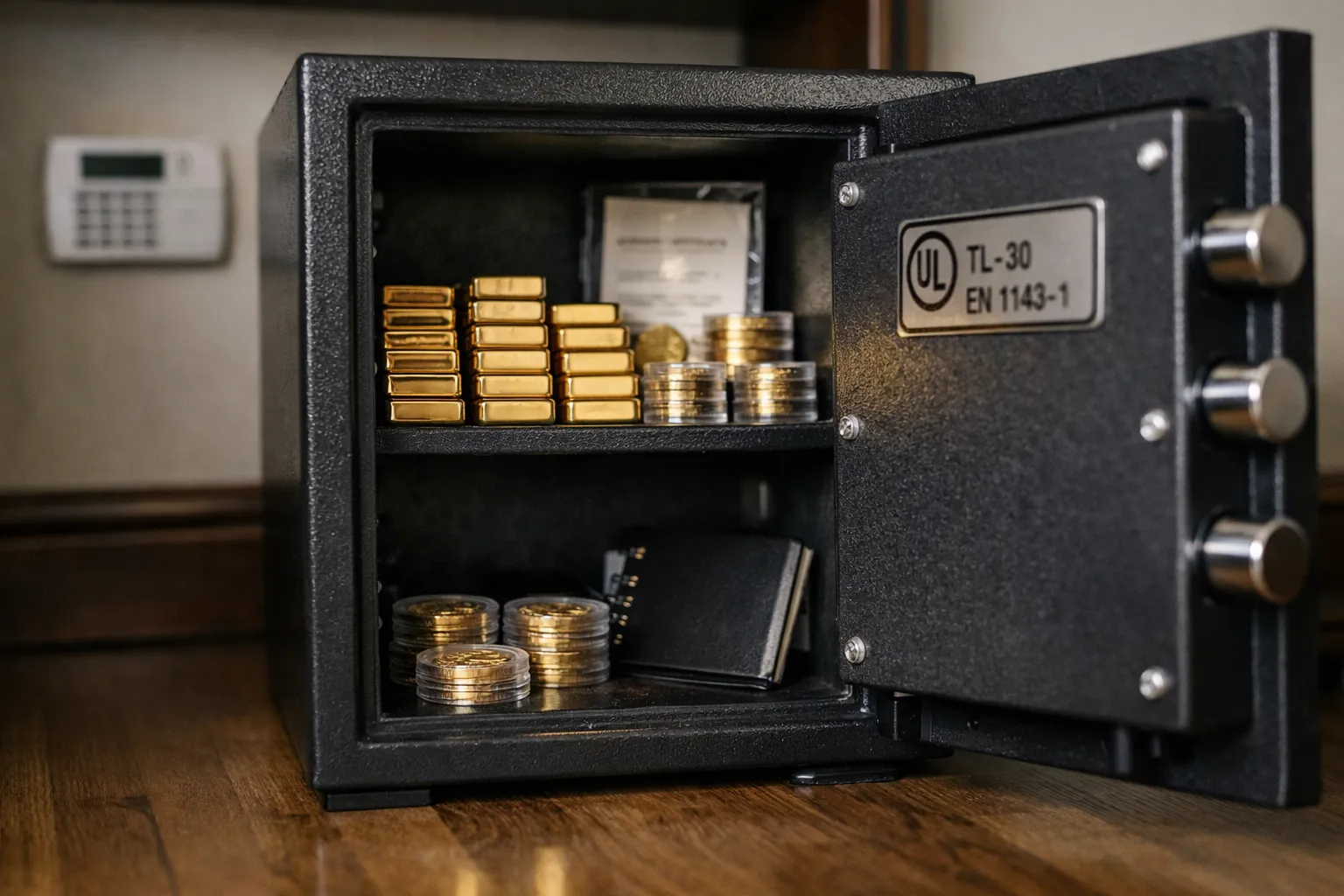
Many gold investors value direct control over their metal. Home storage can give instant access and privacy that vaulted solutions don’t. But doing it properly requires more than buying a safe: you must match the physical security to insurer requirements, document provenance, understand tax and reporting implications, and plan a safe exit strategy when you sell. This guide walks through the steps—practical, actionable and current for October 2026—to set up, insure and manage home storage for investment-grade gold.
1. Decide whether home storage fits your objectives
Home storage is appropriate when you prioritize immediate access, privacy, or want to avoid recurring vault fees. It’s less attractive when you need institutional custody, want minimal operational chores, or hold very large values that complicate insurance and transport.
- Ideal for: modest to mid-size allocations (typical individual holdings up to low six figures), collectors who value specific coins/bars, investors who need quick liquidity for local sales.
- Not ideal for: very large allocations, investors seeking fully segregated, insured institutional custody or those who travel frequently with bullion.
2. Choose the right bullion to store at home
Selecting coin and bar types affects security, resale and documentation:
- Smaller units (1/10 oz, 1/4 oz, 1 oz coins) are easier to sell locally and fetch competitive dealer spreads.
- 1 oz and fractional bars strike a balance between value density and liquidity.
- Large kilo or 400 oz bars concentrate high value into small space but complicate sales and authentication unless you sell to institutional buyers.
- Prefer branded, well-known products (e.g., American Gold Eagle, Canadian Maple Leaf, South African Krugerrand, or LBMA-recognized refiner bars) because they carry stronger resale value and easier provenance.
3. Physical security: safes, installation and concealment
Insurers and professional dealers care about safe ratings and installation. Follow these steps:
3.1 Choose a safe with the right ratings
- Tool-resistance standards: look for UL TL-15 or TL-30 (Underwriters Laboratories) or EN 1143-1 Grade 0–3. TL-15 resists a common-tool attack for 15 minutes; TL-30 for 30 minutes—insurers often require these minimums for higher-value coverage.
- Residential Security Containers (RSC) are commonly sold but may not suffice for high-value bullion without an insurer endorsement.
- Fire rating: select a safe with a published fire rating (usually expressed in minutes/hours and temperature). While ratings vary, a 60–120 minute rating for documents and valuables is common and desirable.
3.2 Installation and anchoring
- Anchor the safe to concrete or a structural floor—insurers often require bolting to reduce theft risk.
- Avoid obvious locations (master bedroom floor closets visible to burglars). Professional installers recommend interior walls, hidden rooms, or reinforced floor mounting.
3.3 Concealment and layered security
- Use layered measures: alarm system, reinforced door locks, motion sensors, exterior lights and, if practical, a monitored alarm that notifies a security provider.
- Consider additional deterrents such as dummy safes or decoy drawers to reduce the probability of successful thefts.
4. Insurance: get the right coverage and documentation
Standard homeowner policies commonly treat bullion under jewelry or "valuable items" limits, which are frequently low (often between $1,000 and $3,000). For meaningful bullion coverage you must take action.
4.1 Types of coverage
- Rider / scheduled personal property: a policy endorsement that lists the bullion and its insured value, usually requires receipts and appraisals.
- Inland marine or "valuable articles" insurance: broader protection for transport and storage and typically used for collectibles and bullion.
- Specialty insurers and private client policies (for high net worth households) offer tailored coverage and higher limits—major providers include large private-client divisions (e.g., Chubb, AIG Private Client Group) and smaller specialty underwriters.
4.2 What insurers will ask for
- Documentation: purchase receipts, assay/certificate for bars, serial numbers, photographs, and a stamped inventory. Keep originals in a separate secure location (e.g., safety deposit box or digital storage with encrypted backups).
- Safe details: make, model, rating and proof of anchoring and alarm systems. Many insurers require a specific safe rating to insure higher amounts.
- Valuation and appraisal: up-to-date declared values. Policies may require periodic re-appraisal as metal prices change.
4.3 Typical costs and structuring
Premiums vary with location, safe rating, and declared value. As a practical guide, expect to pay a small fraction of insured value annually—often in the low single-digit percentages or less for well-secured risks. Get quotes from multiple insurers and ask precisely what is excluded (for example, certain unattended transportation risks).
5. Documentation and provenance: prepare for resale and claims
Good records preserve resale value and speed insurance claims:
- Create a detailed inventory: date of purchase, dealer, lot number, coin/bar type, serial numbers and assay marks. Keep one electronic and one paper copy in separate secure locations.
- Photograph each item clearly, include close-ups of hallmarks, serial numbers and packaging. Video walkthroughs add time-stamped proof of condition.
- Retain original packaging, assay certificates and purchase invoices—buyers and insurers prefer intact provenance.
- Record storage conditions and any maintenance; if you open sealed bars/coins, note when and why.
6. Legal and tax considerations (high-level)
Tax and reporting rules vary by country; treat the following as practical pointers and consult a local tax adviser before changing your storage or selling strategy.
- United States: gold bullion is treated as a collectible for federal income tax; long-term capital gains on collectibles are taxed at a maximum 28% federal rate (state taxes may apply).
- United Kingdom and many EU countries: investment gold (defined under local law) is often VAT-exempt, but capital gains tax or equivalent can apply on sales—keep accurate records.
- Cross-border movement: many customs jurisdictions require declaration of precious metals above thresholds and can subject movement to administrative checks. Check customs rules before travel and use professional transport services for large values.
- Estate planning: include bullion in wills or trusts and consider how heirs will access and liquidate stored metal. Clear inventory and legal titling avoid disputes and loss of value post-mortem.
7. Moving and selling gold from home storage
Selling from home storage requires extra care to preserve value and personal safety.
7.1 Preparing gold for sale
- Reassemble provenance (receipts, assay certificates, photodocumentation).
- Get a fresh assay or verification if material has been out of market for years. Some buyers will discount items without current authentication.
- Decide on the sale channel: local reputable dealer, national bullion buyer, auction house for rarities, or private sale with escrow.
7.2 Secure transport
For significant amounts use professional armored carriers (Brinks, GardaWorld and similar firms operate in many jurisdictions). For smaller transactions choose a dealer that will pick up items or meet you at a secure location—never invite strangers to your home to inspect high-value items.
7.3 Payment and AML/KYC
Expect identity verification and AML checks for larger sales. Payment methods include bank transfer, cashier’s check or escrow. Avoid large cash payments in unsecured settings.
8. What to do in case of loss, theft or damage
- Contact local law enforcement and obtain a police report—insurers typically require this.
- Notify your insurer immediately and follow their claims process—have inventory and proofs ready.
- If multiple items are missing, contact your bullion dealer network and share serial numbers and photographic proof to aid recovery and block resale channels.
9. Practical checklist to set up home bullion storage
- Decide what percentage of your gold allocation to keep at home.
- Buy bullion from reputable dealers; keep receipts and assay certificates.
- Purchase a safe with TL-15/TL-30 or EN 1143-1 rated equivalent and a suitable fire rating.
- Anchor and professionally install the safe; integrate alarms and monitoring.
- Obtain specialized insurance (scheduled personal property or inland marine) with adequate limits.
- Create and store an off-site inventory and photographic record.
- Plan transport and sale routes before you need them (identify dealers, armored carriers, escrow services).
- Consult a tax adviser for reporting, CGT and estate planning implications in your jurisdiction.
10. Final considerations and trade-offs
Home storage gives control and instant access, but it requires ongoing operational discipline: maintaining records, renewing insurance, and ensuring the physical security keeps pace with any change in the value held. For many investors a mixed approach—keeping a core in institutional vaults for scale and portions at home for liquidity or sentimental items—combines the best features of both worlds.
For readers planning home storage in 2026: get written insurer approval for your safe and coverage before you move significant amounts into the house; retain professional installers and use armored carriers for high-value moves. With the right preparations, home storage can be reliable, insured and practical—without sacrificing liquidity or resale value.