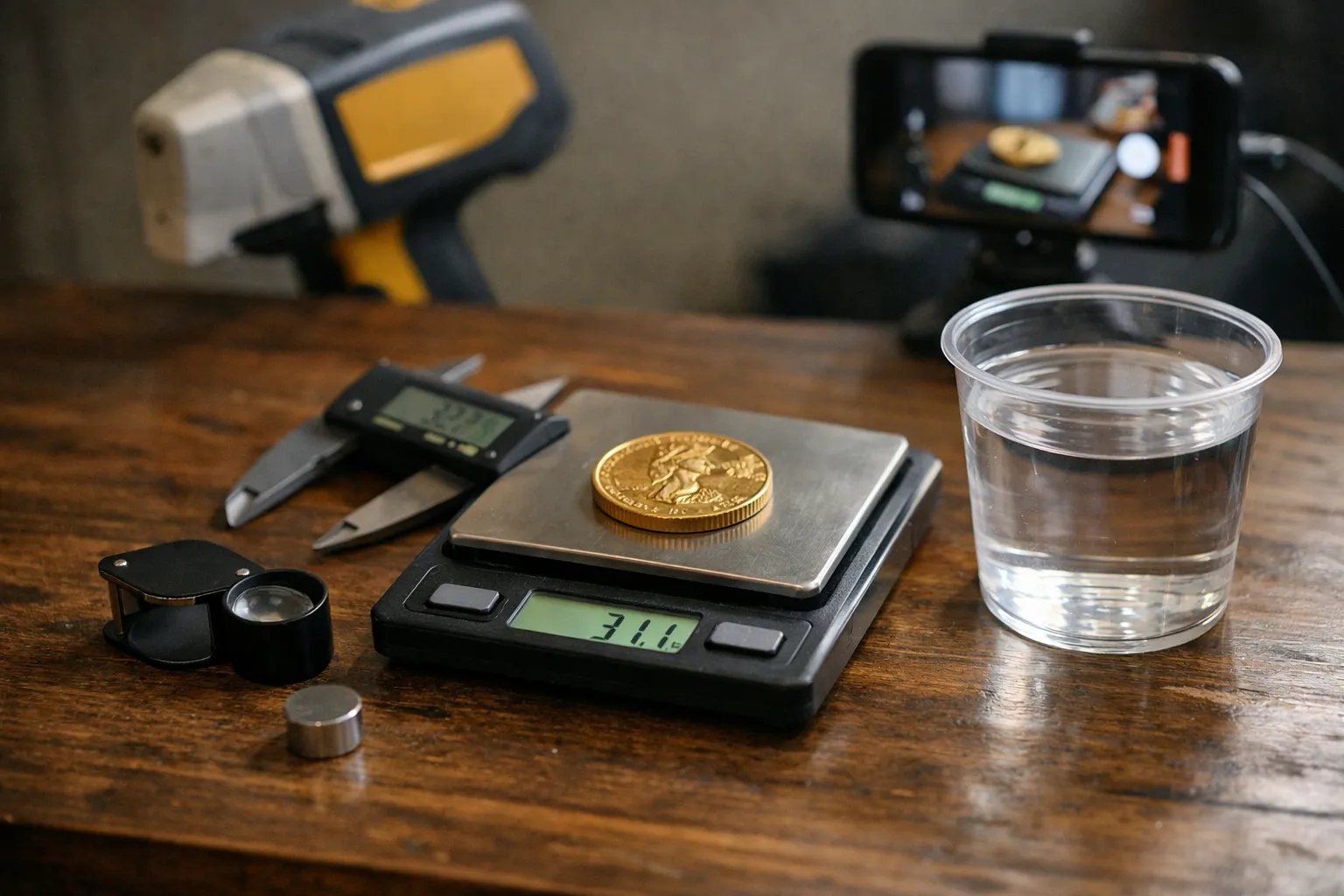
Buying secondhand gold—on marketplaces, at auctions, or from private sellers—can save money but carries added risk. Counterfeiters have become more sophisticated and buyers now face plated bars, tungsten cores inside coins, recycled fakes, and doctored documentation. This guide gives gold-investing enthusiasts a practical, step-by-step workflow to verify coins and bars in 2026: what to check before you buy, how to test an item when it arrives or at a meetup, which tools and labs to use, red flags to watch for, and what to do if something is suspicious.
1. Start before you click: pre-purchase checklist
Much fraud is prevented by due diligence. Before committing to a purchase, run this checklist.
- Know the item specs. Go to the mint or refinery website and record the official mass (gross and fine weight), diameter, thickness and purity (fineness). Example: a modern 1 oz Canadian Maple Leaf is 31.1035 g fine gold (0.9999) with published diameter and thickness.
- Seller credibility. Prefer established dealers with buyback/pricing policies. For marketplaces, review seller history, feedback, and return terms. New sellers with high-volume listings or limited history are higher risk.
- Ask for provenance. Request original receipts, assay cards, serial numbers (for bars), photos of hallmarks and packaging. Serial numbers can sometimes be checked against refinery registries.
- Request specific photos. Ask for high-resolution, unaltered images showing obverse/reverse, edge, packaging, assay card, and a photo of the item on a scale displaying the exact weight number. A professional buyer will be asked to take raw photos on request.
- Payment & escrow. Avoid irreversable payment methods (cryptocurrency, wire transfers) with private sellers. Where possible use escrow or credit cards on marketplace platforms to retain dispute remedies.
- Plan logistics. For local deals, meet at a bank branch or police station; for shipped items, insist on insured, trackable courier (Brinks, Loomis, FedEx with declared value).
2. Low-cost in-hand checks (first-line screening)
If you inspect the item yourself—at a dealer, meet-up, or after receipt—start with non-destructive, low-cost checks. These catch most sloppy counterfeits.
Tools to have on hand
- Digital scale (0.01 g accuracy)
- Digital caliper (0.01 mm)
- 10x–20x jeweller’s loupe
- Small but strong magnets (neodymium)
- Clean container and distilled water for specific-gravity test
- Soft cloth, cotton gloves, and a smartphone for photographing results
Step-by-step screening
- Visual inspection. Use the loupe: check strike details, font, date and mint marks, reeding, and micro-engraving/security marks (e.g., Canadian Maple Leaf micro-engraving, PAMP Kinebar features). Blurred detail, uneven edges or incorrect fonts are red flags.
- Weight. Place the item on a calibrated 0.01 g scale. Compare to the mint/refinery spec. Small tolerances exist; record the measured value.
- Dimensions. Measure diameter and thickness with a caliper. Compare to the spec. Many counterfeits will have incorrect diameter or thickness due to different cores or plating.
- Magnet test. Gold is non-magnetic. A strong neodymium magnet should not attract pure-gold items. If the item sticks or is noticeably attracted, it is almost certainly not pure gold (or contains magnetic alloys).
- Specific-gravity test (Archimedes). For a more reliable density check: weigh the dry item (Wdry), suspend it in distilled water and record the apparent submerged weight (Wwater). Density = Wdry / (Wdry − Wwater). Compare to the expected density (pure gold ≈ 19.32 g/cm³). Important: this test requires that the piece has no air cavities and may be less reliable for heavily plated items. Always record calculations and photos.
- Ping/ring test and feel. Experienced collectors can often hear differences when a coin is gently struck; apps exist to record frequency. This is a subjective test and should not be relied on alone.
Note: Do not use chemical acids unless you accept damaging the item. Acid tests are destructive and not recommended for collectible coins.
3. When low-cost tests are inconclusive: advanced non-destructive checks
Sophisticated counterfeits—especially tungsten-core plated bars or plated coins—can pass weight and gravity checks. These require instrument-based analysis.
X‑ray fluorescence (XRF)
XRF analyzers provide elemental surface composition without damaging the item. Handheld models are commonly used by dealers and labs (examples: Thermo Fisher Niton, Bruker S1 series). XRF reads the alloy at the surface; it doesn’t detect a different core under a thick plating, but it will reveal unexpected surface metals (e.g., significant copper, nickel or silver) and approximate purity.
Ultrasound and radiography
Ultrasound thickness and radiography (X-ray imaging) can detect dissimilar cores inside a gold bar or coin. These are specialized tests performed by assay houses and lead refiners.
Where to get advanced testing
- Professional dealers: many reputable dealers offer on-site XRF scans or will arrange testing.
- Independent assay labs: SGS, Metalor, Intertek and several national assay offices provide non-destructive and destructive assays on request.
- Numismatic grading services: PCGS and NGC authenticate and encapsulate coins; they provide a third-party guarantee for slabbed items.
Costs: expect simple XRF scans at a dealer to cost $0–$50 or be complimentary with purchase. Formal lab assays or ultrasonic analysis for a single item can range from $50–$300 depending on turnaround and whether destructive testing is used.
4. Item-specific considerations
Different product types require different expectations.
- Minted sovereign coins (Maple Leaf, Britannia, Krugerrand, Eagle): Know the issuer’s purity and whether the coin is 24k (999.9) or alloyed (22k Eagles, Krugerrands). Some modern coins include micro-engraving or laser features—learn what they look like for each issue and year.
- Cast bars vs minted bars: Minted bars from recognized refiners (PAMP, Valcambi, Argor) often have security features, serial numbers and assay cards. Cast or poured bars are common for small dealers and private sales; they are harder to authenticate by photo and often require in-hand testing.
- Sealed products: Original blister packs and sealed assay cards add confidence, but seals can be forged. Don’t accept a seal alone as definitive proof.
5. Red flags and scams to watch for
- Prices far below spot with “no questions asked” offers.
- Seller pressure to close the deal quickly or insistence on wire/crypto payments.
- Unclear photos, blurred edges, or repeated stock images.
- Buy-it-now listings with mismatched serial numbers or recycled images across listings.
- Requests to meet in non-public or remote locations; inability/refusal to provide provenance or assay documentation.
6. If something looks wrong: your options and escalation
If a purchase fails a test or you have reasonable suspicion:
- Stop engagement. If you’re still in the negotiation phase, cease communication and don’t transfer any funds.
- Return under seller/marketplace policy. If shipped, use the platform’s claims process—document with photos, time-stamped videos, and measured test results.
- Request third-party assay. For high-value items, insist on an assay from an accredited lab. If the lab confirms fraud, the evidence is generally sufficient for marketplaces, payment processors and law enforcement.
- Payment disputes and chargebacks. For credit card or PayPal purchases, open a dispute immediately; include the lab report and photos.
- Report fraud. Notify the marketplace, your payment provider, and local law enforcement. If serial-numbered items are involved, share details with the refinery or mint.
7. Practical workflows: three common buyer scenarios
Scenario A — Private-sale 1 oz coin meet-up
- Arrange meeting at a bank branch. Bring a compact digital scale, caliper, magnet and loupe.
- Confirm the seller’s photo IDs and original receipt. Photograph the exchange.
- Run the quick screening: visual, weight, caliper, magnet, and, if comfortable, specific-gravity test using a small water container and a thread to suspend the coin.
- If anything is off, decline and walk away; suggest escrow or third-party verification before payment.
Scenario B — Auction or estate sale purchase
- Assume items are sold “as is.” Check auction house authentication policies and post-sale return windows.
- Upon receipt, perform in-hand screening immediately and photograph everything on arrival for provenance.
- If suspect, arrange an assay and open a dispute with the auction house citing independent lab results.
Scenario C — Online marketplace buy with insured shipping
- Before purchase, ask seller for serial numbers, assay cards, and close-ups. Prefer listings with insured courier shipping and full return policy.
- Immediately on arrival, record an unboxing video and perform the in-hand checks.
- If the item fails verification, open the marketplace’s dispute and arrange a lab assay.
8. Tools and services: what to buy, what to outsource
For most enthusiasts, a modest toolkit plus access to reputable dealers and labs is the most cost-effective approach.
- Buy: digital scale (0.01 g), calipers, loupe, neodymium magnet, small container and distilled water. Expect $50–$150 total.
- Consider: a specific-gravity kit or cheap suspension rig to make gravity tests repeatable.
- Outsource: XRF, ultrasound, radiography and destructive assays. Handheld XRF analyzers cost tens of thousands of dollars and are overkill for occasional buyers.
- Third-party guarantors: PCGS/NGC for coins; accredited assay labs (SGS, Metalor, Intertek) for bars and high-value items.
9. Record-keeping and resale considerations
Maintain a file with purchase receipts, assay reports, photographs and testing logs. Good documentation preserves resale value and simplifies claims if authenticity issues arise later. When selling, provide prospective buyers with the same documentation you wish you had received.
10. Final checklist (quick reference)
- Pre-purchase specs verified on issuing mint site.
- Seller credibility and return policy confirmed.
- Photos requested showing serials, markings, and scale readout.
- On receipt or meet-up: visual, weight, dimensions, magnet and specific-gravity tests performed and recorded.
- If inconclusive: obtain XRF or lab assay; use PCGS/NGC for coins where appropriate.
- Preserve documentation and use insured shipping and secure meeting locations.
Buying secondhand gold is a practical way to build or top up a bullion position, but it requires discipline. With a simple toolkit and a methodical verification workflow—backed by access to professional labs when needed—you can reduce risk substantially. When in doubt, slow down: the time and modest cost of third‑party verification are small compared with the loss of a counterfeit high‑value item.