
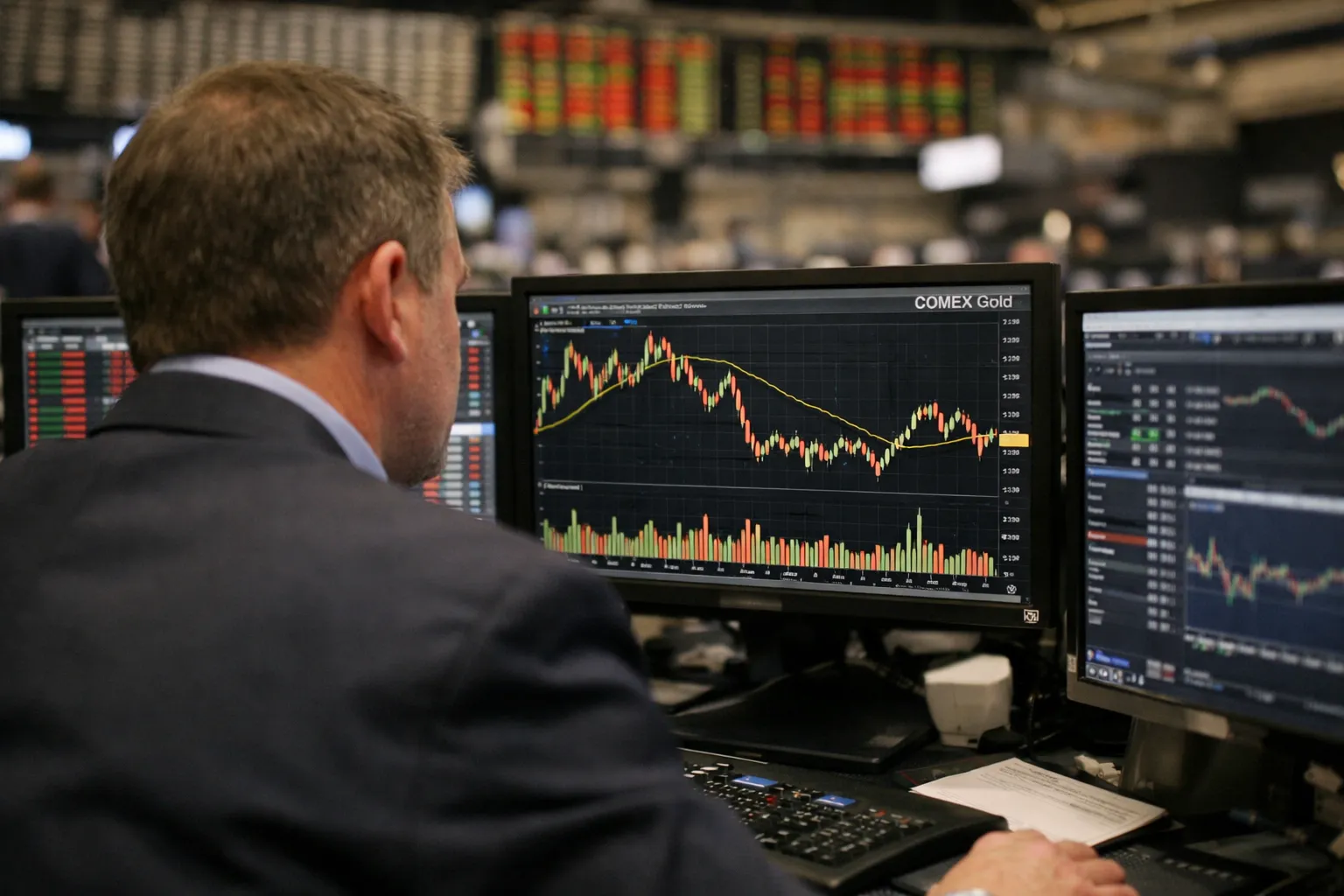
CHICAGO — Who: CME Group on COMEX; What: a listed 1‑troy‑ounce gold futures contract; When: launched April 13, 2026 and now trading through November 2026; Where: CME Globex electronic market and CME ClearPort clearing; Why: to let smaller traders and dealers hedge ounce‑level exposure with exchange‑cleared liquidity. Seven months after launch, the question is no longer whether the contract exists — it's whether it meaningfully improves execution economics versus ETFs and physical bullion for your use case.
Context — why November 2026 matters
The 1‑oz contract was pitched as a bridge between 100‑oz COMEX contracts and bullion/ETF exposure. The numbers through October show that bridge is usable for some traders but still contains practical frictions: per‑ticket fees, intraday variation margin, and time‑of‑day liquidity remain decisive. Since June, adoption has grown but unevenly: the contract is beginning to be used by small dealers and active traders during U.S. core hours, but it still behaves like a niche product outside that window. The numbers tell a different story than the marketing: smaller notional lowers entry barriers, but it does not automatically remove transaction or funding costs.
Key developments since the April–June update
- Liquidity increased, but concentrated by session: average displayed depth at the NBBO during U.S. core hours (9:30–16:00 ET) has materially improved from April levels; market‑makers now routinely show 5–15 contracts at best bid/offer during core U.S. hours. Outside those hours, displayed size is often under 3 contracts and spreads widen.
- Open interest and ADV trended upward: open interest grew steadily through September and October, indicating positions being carried rather than churned. Average daily volume (consolidated across brokers) rose severalfold from the early weeks — the key takeaway is that a reliable execution window has emerged for U.S. daytime traders.
- Broker practices diverged: some futures brokers and retail platforms removed or reduced per‑ticket minimums for single‑contract trades in Q3 2026, while others maintained $1–$5 ticket minimums. Clearing firms also clarified margin offsets for hedged gross positions, which benefits coin dealers using nets rather than legging through independent accounts.
- Margin remained modest but matters to small accounts: reported initial margins cluster in the 3–6% range of notional depending on clearing firm and realized volatility. That produces low dollar amounts per contract but significant cash draw relative to small account sizes.
Updated specifics to verify with your broker — do this now
- Tick size and tick value: confirm the official tick increment and dollar tick value. Typical tick = $0.10 → $0.10 per contract per tick; a 4‑tick quoted spread therefore costs $0.40 round trip before commissions.
- Settlement mechanics: confirm whether you face financial settlement or physical delivery, and the exact reference window for settlement pricing — this remains crucial for dealers who plan to take or make physical metal.
- Published initial & maintenance margin: get the clearing‑firm dollar figures, not just percentage estimates. Example math below shows why small dollar margins are still meaningful for tight cash accounts.
- Commission and per‑ticket fees: ask whether minimum ticket fees apply on single‑contract round trips. A $2 per‑ticket charge turns a $0.40 spread into a $2.40 round‑trip cost — that changes the breakeven versus ETFs.
Concrete cost math — November 2026 examples
Use live numbers from your broker and current spot. Example baseline (swap in real figures):
- Spot gold = $2,000/oz → notional per 1‑oz contract = $2,000.
- Initial margin = 4% → cash required = $80 per contract. At 6% → $120.
- Tick value = $0.10. If average quoted spread = 4 ticks → round‑trip spread cost = $0.40 (≈0.02% of notional). Add a $1 per‑ticket broker fee → one‑contract round trip = $1.40 (~0.07% of notional).
- Compare to ETFs: many physically backed gold ETFs carry TERs in the 0.12–0.40% range; bid/ask spreads for ETFs in normal markets are often 0.02–0.10% of NAV. For holding periods longer than a few days, ETF TER and spread frequently beat single‑contract futures once you include ticket fees and margin‑related funding risk.
Practical market behavior — what November shows
Execution is increasingly predictable in U.S. core hours but still uneven overnight. Two practical signals to watch now:
- Quoted spread during your trade times: sample 10 live orders at your intended trading hour. If average executed slippage (relative to midpoint) exceeds your cost tolerance, reconsider.
- Displayed depth at best bid/offer: if depth is consistently 5 contracts and you trade more than a few contracts, use limit orders or split executions to avoid market impact.
Who benefits now — and the remaining pitfalls
Retail active traders
Benefit: fine‑grained position sizing and lower notional per contract. Pitfall: if your broker charges per‑ticket minimums or you trade outside U.S. core hours, your effective round‑trip cost can exceed ETF alternatives for multi‑day holds.
Coin dealers and micro‑hedgers
Benefit: many dealers report the contract reduces basis mismatch when their inventory is ounce‑level and timing aligns with the contract’s settlement window. Pitfall: settlement mismatch and local physical premiums remain — this is a hedging tool, not a direct replacement for logistics of physical delivery.
Long‑term investors
For buy‑and‑hold allocation, ETFs or allocated bullion still remove variation margin, intraday funding risk and operational roll complexity. Use the 1‑oz futures for tactical hedges and short‑term position sizing, not for passive long‑term holdings.
Reactions and what to watch next (next 30–90 days)
Adoption will hinge on three practical items: (1) whether more brokers remove per‑ticket minimums for small futures trades, (2) whether market‑makers maintain displayed depth outside U.S. hours, and (3) whether open interest and ADV continue steady month‑over‑month growth. If those happen, the 1‑oz contract will move from a niche instrument to a routine tool for micro‑hedgers and small active traders.
Updated checklist — what to do this week
- Download the CME contract spec today and print the tick, margin and settlement sections.
- Call your broker’s futures desk and confirm: live symbol, routing, initial/maintenance margin (dollar values), per‑ticket charges, and whether the contract is in their demo environment.
- Paper‑trade the exact order sizes and times you plan to use for two weeks and log executed price vs. displayed NBBO.
- Calculate round‑trip cost per intended holding period including spread, commissions, ticket fees and expected margin funding. If one‑contract round trip costs >0.15% of notional and you plan to hold more than 10 trading days, prefer ETFs or allocated bullion.
- Set dollar‑based liquidity limits and variation‑margin tolerance — small contracts reduce notional risk but not tail risk from rapid volatility.
FAQ
Is the 1‑ounce contract physically deliverable?
Check CME’s published contract specification for delivery terms. Some small‑notional contracts are financially settled; others allow delivery. Delivery mechanics (location, assay, timing) matter for dealers who plan to take physical metal.
What margin should I expect to post per contract?
Margins vary by clearing firm and volatility. Expect initial margin typically in the 3–6% range of notional — roughly $60–$120 on a $2,000 notional contract. Always obtain the exact dollar margin from your broker before trading.
When does the 1‑oz futures beat ETFs on cost?
For intraday to short‑term trades where you can execute during U.S. core hours, and if your broker has low or zero per‑ticket fees, futures can be cheaper due to minimal TER. For multi‑day holds, ETFs often win once you factor in per‑ticket fees, margin funding risk and operational friction.
Can I net futures margin against other positions to reduce funding?
Some clearing firms allow margin offsets for hedged gross positions within the same clearing relationship. Ask your broker whether they permit cross‑product offsets and how they calculate net margin; policies differ materially between FCMs.
What is the single most important test before trading live?
Paper‑trade your exact order sizes at the times you will trade for at least two weeks and calculate your true round‑trip cost (spread + commissions + ticket fees + margin funding). If the math doesn't beat your ETF or physical alternative for your target holding period, wait.